Estate Planning Marketing: How to Build a Predictable Client Pipeline
Estate planning marketing works when paid search, organic SEO, and CRM automation operate as a single acquisition system, not as isolated experiments. Attorneys who rely only on referrals trade predictable growth for uncertainty. The firms consistently adding new clients combine Google Ads that capture high-intent searches, content that builds long-term trust, and automated follow-up that converts leads before they go cold. This guide covers all three.
Estate planning attorneys know their craft.
Most of them are less confident about marketing it.
Referrals carry the practice for a while. Then growth stalls. New clients arrive in unpredictable bursts, and there is no clear way to turn the volume up or down.
That is not a referral problem. It is a systems problem.
This guide walks through the three-channel acquisition system that estate planning firms use to build consistent, measurable client pipelines: paid search, SEO, and CRM automation working together.
Why Estate Planning Marketing Requires a Different Approach
Estate planning marketing is different from other legal marketing because the decision to hire an attorney is rarely urgent.
Someone searching for a DUI lawyer needs help today.
Someone thinking about a will might sit on that thought for months before picking up the phone.
That delay changes everything about how you market.
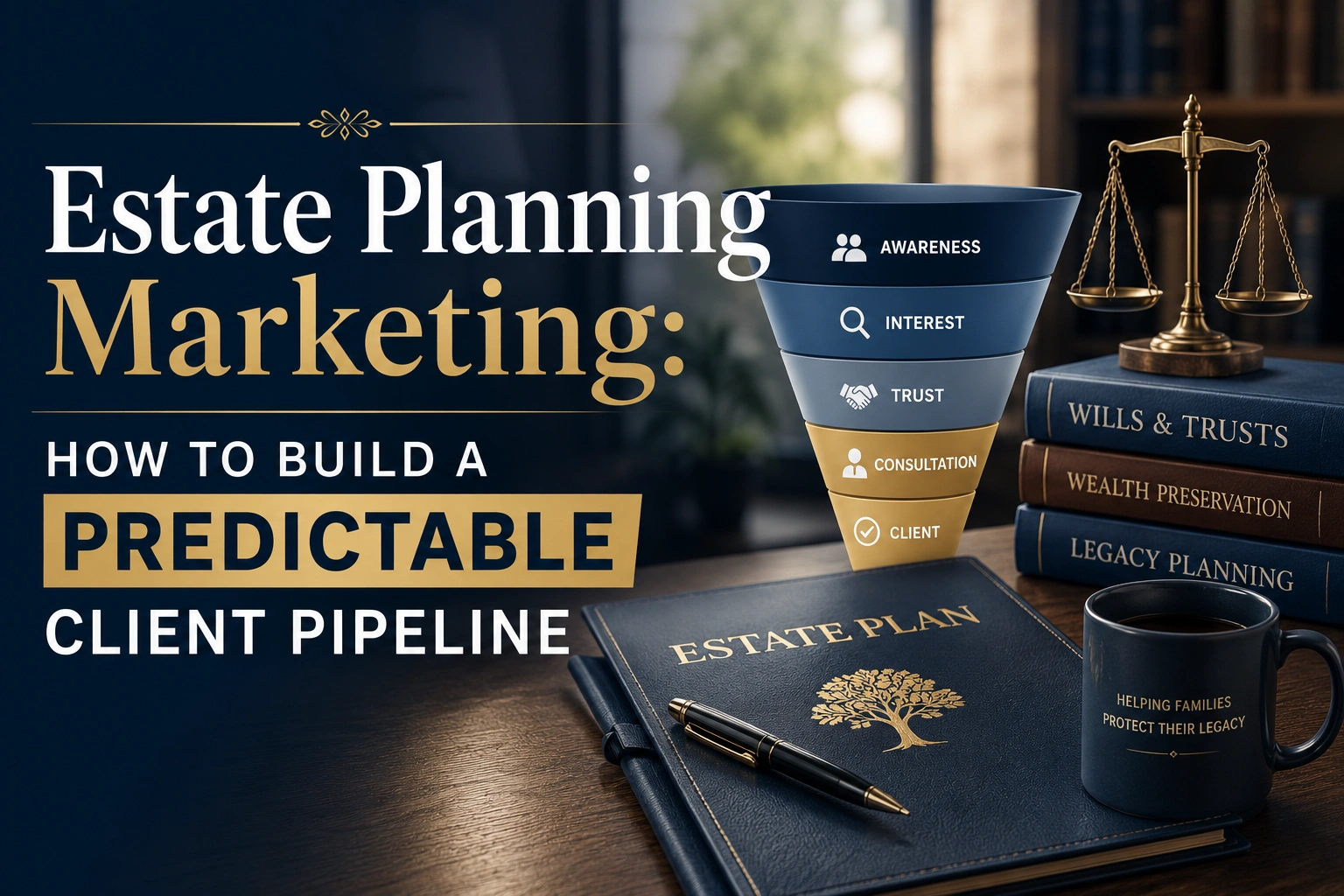
Your strategy needs to meet potential clients at every stage: when they first start researching, when they are actively comparing firms, and when they are finally ready to book a consultation.
Less than half of American adults have a will or estate plan, which means the pool of people who need your services is enormous.
The question is whether they find you or someone else.
The Three Channels That Drive Consistent Client Acquisition
Effective estate planning marketing isn’t about picking the right tactic.
It’s about building three systems that work together: paid search to capture demand now, SEO to build demand over time, and CRM automation to convert the leads you’re already generating.
Firms using this kind of multichannel acquisition approach grow revenue 135% faster than those relying on a single channel.
Google Ads and Local Services Ads: Capturing High-Intent Searches
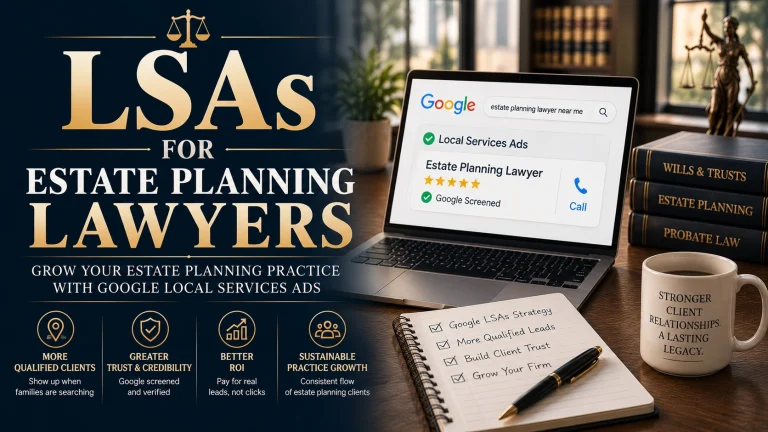
Google Ads and Local Services Ads (LSAs) are the fastest way to put your firm in front of people who are ready to act.
When someone types “estate planning attorney near me” or “create a living trust,” they’re not browsing. They’re ready to talk to someone.
The key is targeting the right keywords.
Phrases like “estate planning for new parents” or “revocable trust attorney” convert better than broad terms like “estate planning” because they match exactly what a motivated prospect is searching for.
LSAs go a step further.
They appear at the very top of Google search results and only charge you when someone calls or messages your firm directly.
The Berdan Law case study shows what this looks like in practice.
In three months, a solo estate planning firm generated $60,000 in signed-case revenue from $8,315 in ad spend.
That is 183 qualified leads at $39.97 per lead and an 8.2x return on ad spend.
The difference between that result and a wasted ad budget comes down to one thing: tracking signed cases, not just clicks.
Ad spend only matters if it turns into revenue.
SEO and Content Marketing: Building Long-Term Visibility
68% of people turn to Google first when they start thinking about estate planning, before they ask a friend or family member for a referral.
If your firm doesn’t appear in those early searches, you’re invisible to a large share of your potential clients.
SEO builds that visibility over time by making sure your website ranks when people search for the services you offer in your area.
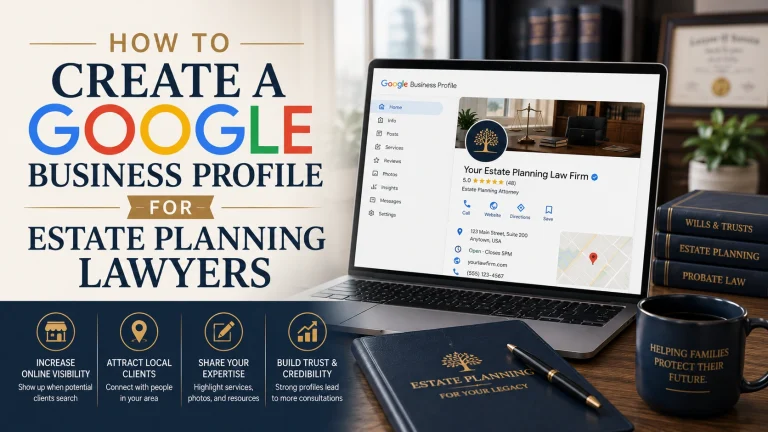
This means creating and optimizing your Google Business Profile, earning reviews, building location-relevant pages, and creating content that answers the questions your ideal clients are already asking.
Good content topics for estate planning firms include:
- What happens if you die without a will in your state?
- How much does a living trust cost?
- What’s the difference between a will and a trust?
- When should I update my estate plan?
These aren’t just blog post ideas.
They are the exact phrases people type into Google before they are ready to hire anyone.
Showing up in those results builds trust before the first phone call.
CRM and Follow-Up Automation: Converting Leads Into Signed Cases
Most estate planning firms lose leads not because the leads are bad, but because there’s no system to follow up.
A potential client fills out your contact form on a Thursday evening.
If someone doesn’t respond until Monday morning, that person has probably already called two other firms.
A CRM system solves this by automating the first response.
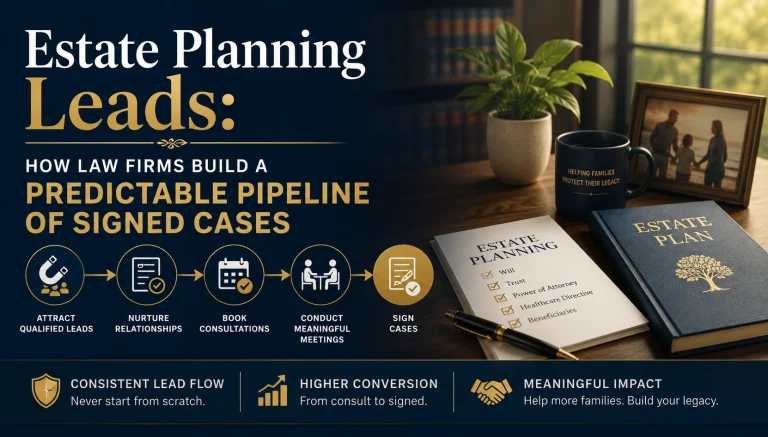
The moment a lead comes in, they receive a message, a booking link, or a call from your intake team.
No lead sits unattended.
Automation also handles longer nurture sequences for prospects who aren’t ready to book yet.
A monthly email, a reminder about life events that trigger estate planning needs, or a simple check-in can bring a warm lead back when the timing is right.
This is the part of estate planning marketing that most firms skip, and it is where a significant amount of revenue quietly disappears.
How to Position Your Estate Planning Firm Before You Spend a Dollar on Marketing
The biggest mistake attorneys make before investing in marketing is skipping positioning.
Without a clear answer to “why should someone choose us,” no amount of ad spend or content will fix a weak conversion rate.
Define Your Ideal Client Profile
Not every estate planning client is the same.
Young families need basic wills and guardianship designations.
High-net-worth individuals need trust structures and tax planning.
Business owners need succession planning.
Seniors need Medicaid planning and powers of attorney.
Trying to speak to all of them at once means your message resonates with none of them.
Decide who you serve best.
Build your messaging, your website copy, and your content strategy around that person.
Sharpen Your Core Message
Your website’s homepage has roughly five seconds to tell a visitor they’re in the right place.
That means your headline should say clearly who you help, what you help them do, and why you are the right choice.
Avoid generic phrases like “experienced, compassionate legal counsel.”
They appear on every law firm website and say nothing.
Instead, lead with the outcome: “We help families protect what they’ve built with clear, straightforward estate plans.”
What Does It Actually Cost to Market an Estate Planning Practice?
Estate planning marketing costs vary widely depending on your market, your goals, and which channels you use.
Here are realistic benchmarks to plan around.
Google Ads for estate planning keywords typically run $50 to $150 per lead depending on your location and targeting.
Local Services Ads tend to deliver leads at the lower end of that range because you only pay for direct contacts.
SEO is a longer investment.
Most firms begin to see meaningful organic traffic growth between three and six months after starting.
The payoff is compounding visibility that doesn’t disappear when you stop paying for it.
A combined PPC and SEO strategy with CRM systems in place typically requires a monthly budget of $2,500 to $8,000 or more, depending on firm size and competitive market.
Firms that track signed cases rather than clicks consistently see returns that justify and expand that investment.
How Kaizen Growth Helps Estate Planning Attorneys Grow Predictably
At Kaizen Growth, we build integrated acquisition systems for law firms.
That means we handle the paid search campaigns, the SEO strategy, and the CRM automation as a connected whole, not as three separate vendors who never talk to each other.
Our systems-driven approach is built around one outcome: signed clients, not impressions, not clicks, not traffic reports.
The client results we have produced speak to what this looks like in practice.
A solo estate planning firm. A three-month engagement. $60,000 in signed-case revenue from less than $9,000 in ad spend.
We back every engagement with a performance guarantee: 10 signed clients in 10 weeks, or we continue working at no additional cost until we get there.
If you’re ready to stop guessing what your marketing is producing, get in touch and we will walk you through exactly what a growth system for your firm would look like.
The Biggest Estate Planning Marketing Mistakes Attorneys Make
Relying entirely on referrals. Referrals are valuable. They are also unpredictable. Building your entire pipeline around referrals means your revenue fluctuates with other people’s schedules and memories.
Running ads without tracking signed cases. The number of clicks or calls your ads generate is largely irrelevant. The only metric that matters is how many of those contacts became signed clients and what revenue they represent.
Publishing content without a keyword strategy. Writing blog posts about topics your clients do not search for is effort without return. Start with the questions your ideal clients are actually typing into Google.
Ignoring follow-up. Speed to lead is one of the strongest predictors of conversion in legal services. A lead that goes uncontacted for more than a few hours is often a lost opportunity.
Treating website traffic as success. More visitors to your website doesn’t mean more clients. A high-converting website with modest traffic outperforms a high-traffic website that doesn’t make it easy for visitors to take the next step.
Frequently Asked Questions About Estate Planning Marketing
How much should an estate planning attorney spend on marketing?
Most estate planning firms spend between 5% and 10% of their target revenue on marketing. For a firm targeting $500,000 in annual revenue, that is $25,000 to $50,000 per year, or roughly $2,000 to $4,000 per month. The right budget depends on your market, competition, and which channels you are using. Firms that track marketing spend against signed-case revenue consistently get more value from every dollar.
How long does it take to see results from estate planning marketing?
Paid search (Google Ads and LSAs) can generate leads within days of launching a campaign. SEO typically takes three to six months to produce meaningful organic traffic growth. CRM automation starts working immediately but requires consistent lead volume to show its full impact. A combined strategy delivers short-term results through paid channels while building long-term visibility through organic search.
What is the best marketing channel for estate planning attorneys?
There is no single best channel. The most effective estate planning marketing combines paid search for immediate lead generation, SEO for long-term visibility, and CRM automation for conversion. Each channel has a role to play. Paid search captures people who are ready now. SEO captures people who are still researching. CRM converts both into signed clients.
How do I get more estate planning clients without paying for ads?
The most reliable non-paid strategy is SEO paired with consistent content marketing. Optimizing your Google Business Profile, building out location-specific pages, earning reviews, and publishing content that answers your ideal clients’ questions can generate steady organic leads over time. Referral relationships with CPAs, financial planners, and other estate-adjacent professionals are also a strong non-paid channel when cultivated deliberately.
What should my estate planning website include to convert visitors?
A high-converting estate planning website needs a clear headline that states who you help and what you do, a prominent phone number and contact form above the fold, trust signals like reviews and credentials, plain-language descriptions of your services, and a simple next step such as booking a call or requesting a consultation. Mobile performance matters: most potential clients will visit your site on a phone, and slow load times or cluttered layouts cost you consultations.
How do Google Local Services Ads work for estate planning firms?
Google Local Services Ads appear at the top of Google search results, above standard paid ads. They display your firm’s name, rating, and a direct call or message button. You pay only when a potential client calls or contacts you through the ad, not per click. Qualifying requires a background check and license verification, which also earns your firm the “Google Screened” badge. This badge builds trust and increases call rates, making LSAs one of the most cost-efficient paid channels available to estate planning attorneys.