LSAs for Estate Planning Lawyers: What They Cost & Whether They’re Worth It
Local Services Ads let estate planning lawyers pay per lead instead of per click, and they usually cost less than other legal practice areas because these searches aren’t urgent. This guide covers what LSAs cost, how Google’s screening process works, why estate planning clients convert differently than personal injury or family law leads, and a real case where $8,315 in ad spend produced $60,000 in signed cases.
What Are Local Services Ads for Estate Planning Lawyers?
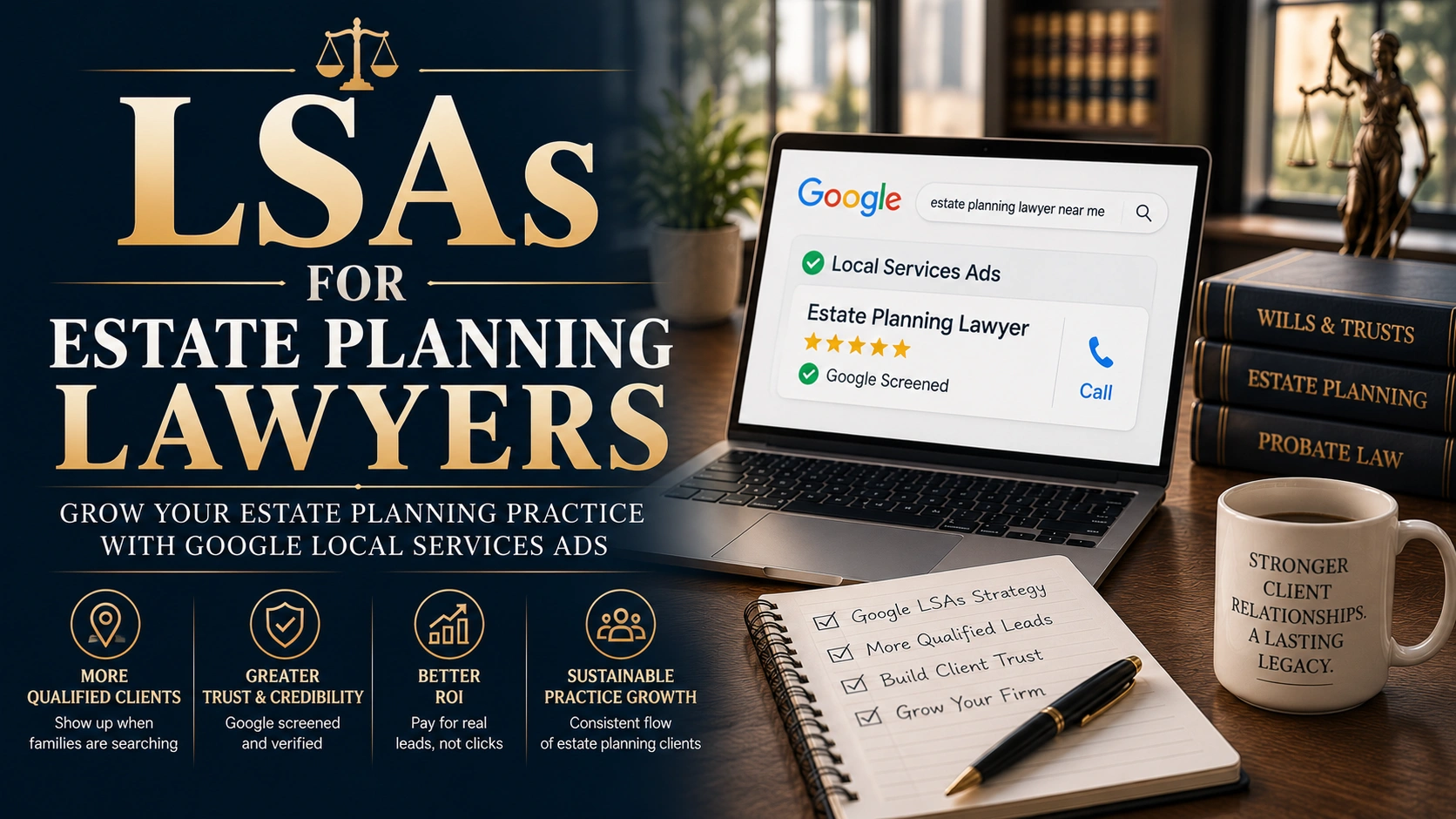
Local Services Ads, or LSAs, are Google’s pay-per-lead advertising format for service businesses, including law firms.
You pay only when someone calls or messages your firm through the ad, not when someone simply clicks it.
For estate planning lawyers, LSAs appear above the regular search results and carry a “Google Screened” badge once your firm passes Google’s verification process.
That badge matters more than it might seem. LSAs and the “more lawyers” expansion link now capture about a third of all first-page clicks that used to go to organic listings or traditional search ads.
Interestingly, the top LSA spot only gets a small share of those clicks on its own.
Most of the traffic spreads across the “more lawyers” list, which means showing up at all matters as much as showing up first.
This is different from Google Ads, where you pay every time someone clicks your ad whether they call you or not.
With LSAs, a lead who scrolls past without calling costs you nothing.
How Much Do LSA Leads Cost for Estate Planning Attorneys?
Estate planning leads through Local Services Ads typically cost between $50 and $120 per lead, making it one of the least expensive legal practice areas to advertise in.
That’s because estate planning searches usually aren’t urgent the way a DUI arrest or a car accident is, so Google prices the category lower than personal injury or criminal defense.
For comparison, the average cost per lead across all legal services sits closer to $111, and personal injury leads can run several times higher than that.
Estate planning’s lower price tag isn’t a downside.
It means a modest monthly budget can produce a steady stream of leads without competing against personal injury firms willing to spend thousands per case.
Not every lead turns into cash.
Firms that use exclusive leads instead of shared leads tend to see conversion rates several times higher, since the prospect isn’t also talking to three other attorneys at the same time.
When you’re comparing platforms, the real number to watch isn’t cost per lead.
It’s cost per signed client, and that depends heavily on how fast and how well your firm follows up.
Why Do Estate Planning Clients Behave Differently Than Other Legal Leads?
Estate planning clients tend to be older, more deliberate, and slower to decide than clients searching for urgent legal help.
They research multiple firms, read reviews carefully, and often wait weeks or months before picking up the phone.
This changes how you should measure and manage an LSA campaign.
A personal injury lead usually calls the first firm that answers.
An estate planning lead might see your ad today and call three weeks later, after mentioning it to a spouse or financial advisor.
56 percent of Americans still have no estate plan at all, which means there’s a large pool of people who know they should act but haven’t yet.
Gen X currently has the highest unprotected rate of any generation, which is worth noting if your firm is deciding where to focus.
Seasonal patterns matter too.
Interest in estate planning tends to rise around the new year, after a death in someone’s extended circle, or following major life events like a new grandchild or a health scare.
Budgets that flex with these patterns tend to perform better than a flat spend every month.
Is Your Practice a Good Fit for LSAs?
LSAs work best for estate planning firms that can answer or return calls quickly, have at least a handful of positive reviews already, and are willing to track which leads actually turn into signed clients.
Firms that let calls go to voicemail or don’t have a system for following up will waste most of their budget no matter how the ads perform.
Before turning on LSAs, take an honest look at your intake process.
Who answers the phone during business hours?
What happens to a call at 7 p.m. on a Tuesday?
If the answer is “it goes to voicemail and we call back the next day,” that’s the first thing to fix, not the ad platform.
How Do You Set Up and Get Verified for Local Services Ads?
Setting up LSAs for an estate planning practice means creating a Local Services profile, passing Google’s screening process, and setting a weekly budget.
Verification includes a background check on the firm and its attorneys, confirmation of an active bar license, and proof of malpractice insurance, which usually takes one to two weeks to clear.
Screening, Background Checks, and Bar Verification
Google runs identity and criminal history checks on the business and its owners, including searches against national sex offender and sanctions registries.
For law firms specifically, Google also confirms that the attorney holds an active license in good standing.
None of this is unusual since most bar associations already require background checks to practice, but gathering the documents ahead of time speeds things up.
Budget and Bid Strategy
You set a weekly budget rather than a per-click bid, and Google uses that number to decide how many leads to send you.
Starting conservatively and increasing the budget once you see which leads convert into real clients is a safer approach than committing to a large spend on day one.
Profile Optimization
Your profile photo, service categories, and service area all affect how often you show up.
Firms that list every relevant service, wills, trusts, probate, and powers of attorney, tend to appear in more searches than firms that only list estate planning as a single category.
Reviews matter here too.
A firm with 20 recent reviews and a strong average rating will typically outperform a firm with three old reviews, even with an identical budget.
What Should Happen After an LSA Lead Comes In?
Every LSA lead should get a call or text within five minutes of coming in, not the next business day.
Leads contacted within five minutes are far more likely to turn into a real conversation than leads contacted thirty minutes later, and that gap only grows the longer you wait.
For a solo attorney juggling client meetings, this usually means some kind of automated first response.
This is where many estate planning firms lose money they already spent.
A lead calls, no one answers, and the prospect moves to the next name on their list.
Setting up automated text replies, a shared intake inbox, or using AI to draft a faster first response can close that gap without requiring the attorney to be on call around the clock.
The point isn’t to replace a human conversation.
It’s to make sure the prospect hears from someone before they call the next firm.
LSAs vs Referrals: Where Estate Planning Firms Get Stuck
Many solo and small estate planning firms grow almost entirely through referrals from financial advisors, accountants, and past clients, and for good reason.
Referred clients tend to stick around longer and trust the firm more from the first meeting.
But referrals also have a ceiling.
A well-connected solo attorney might pick up a handful of new files a month through word of mouth alone, and that pace rarely accelerates on its own.
This is usually the point where firms start asking whether paid ads are worth the risk.
The honest answer is that LSAs work best as an addition to referrals, not a replacement for them.
Referrals fill the pipeline with warm, trusting clients.
LSAs fill the gaps between them with people actively searching who wouldn’t have found the firm otherwise.
Comparing the total cost per signed client across every channel, rather than just the sticker price of a lead, is the only way to know if a channel is actually paying for itself.
A Real Example: How One Solo Estate Planning Firm Turned $8,315 Into $60,000
Berdan Law is a solo wills-and-trusts practice in Richmond, Virginia.
Over three months, the firm spent $8,315 combined on Google Search Ads and Local Services Ads and generated $60,000 in signed estate planning cases, a 622 percent blended return.
The breakdown is useful because it shows how the two channels played different roles.
Search Ads produced 121 leads worth $47,900 in signed cases, while LSAs brought in 62 leads worth $12,100.
Lead volume grew 72 percent over the three months, climbing from 47 to 81 monthly leads as the campaigns matured.
The firm’s owner summed up the lesson simply: ad spend only matters once it turns into signed cases, not clicks or calls.
You can see the full breakdown of that campaign including how leads were tracked from first call to signed engagement.
How Kaizen Growth Helps Estate Planning Firms Turn LSAs Into Signed Cases
Running LSAs well takes more than turning on a campaign and waiting.
Kaizen Growth builds an integrated PPC, SEO, and CRM system specifically for estate planning firms, so paid leads, organic visibility, and follow-up all work together instead of existing as separate experiments.
On the paid side, that means managing your Local Services Ads and Search Ads budget, writing service categories and profile details that match what estate planning clients actually search for, and building a review generation process that keeps your Google Screened profile competitive.
On the follow-up side, it means setting up CRM automation so no lead sits unanswered, with fast text and call responses built into the system rather than left to chance.
The goal isn’t more leads for the sake of more leads.
It’s treating the whole client acquisition process as a single system, where paid ads generate demand, SEO builds long-term visibility, and CRM makes sure the leads you’re already paying for actually turn into signed clients.
Getting Started with LSAs for Your Estate Planning Practice
LSAs aren’t a guaranteed source of clients, but for estate planning firms with a solid intake process, they’re one of the more affordable ways to reach people who are actively looking for help.
Start with a modest budget, get your profile verified, and pay close attention to how quickly your team responds to each lead.
The firms that struggle with LSAs almost always have a follow-up problem, not an ad problem.
If you’re ready to see what a properly managed Local Services Ads campaign could do for your estate planning practice, Kaizen Growth can help you build and run one as part of a complete acquisition system.
Frequently Asked Questions
Are Local Services Ads worth it for estate planning lawyers?
LSAs can work well for estate planning lawyers because the category costs less per lead than most other legal practice areas, and the pay-per-lead structure means you’re not charged for clicks that never turn into a phone call. They work best alongside a fast follow-up process, since estate planning clients tend to be deliberate and will move on to another firm if no one responds quickly.
How much does Google charge per lead for estate planning attorneys?
Estate planning leads through Local Services Ads typically cost between $50 and $120 per lead, depending on your market and competition. This is generally lower than practice areas like personal injury or criminal defense, since Google prices leads partly based on urgency and case value.
What is “Google Screened” and do I need it?
“Google Screened” is a verification badge that appears on your Local Services Ads listing once your firm passes a background check, license verification, and insurance review. It’s required to run LSAs as a law firm, and it also signals to prospective clients that your firm has been vetted, which can help build trust with cautious estate planning clients.
How long does LSA verification take for a law firm?
Verification usually takes one to two weeks, though it can take longer if your firm needs to gather documents like proof of malpractice insurance or bar license confirmation. Starting the process early, before you plan to launch your campaign, avoids unnecessary delays.
Can I dispute a bad lead on Local Services Ads?
Yes. Google allows firms to dispute leads that are clearly spam, outside their service area, or unrelated to the practice areas listed on their profile, and approved disputes are typically refunded as credit. Keeping a record of why a lead didn’t qualify makes the dispute process faster.
Should I choose LSAs or Google Ads for my estate planning practice?
Most estate planning firms benefit from running both, since they capture different parts of the search results and different types of searchers. LSAs charge per lead and appear at the very top of the page, while Search Ads charge per click and can target more specific keywords, so combining them tends to produce more signed cases than relying on just one.