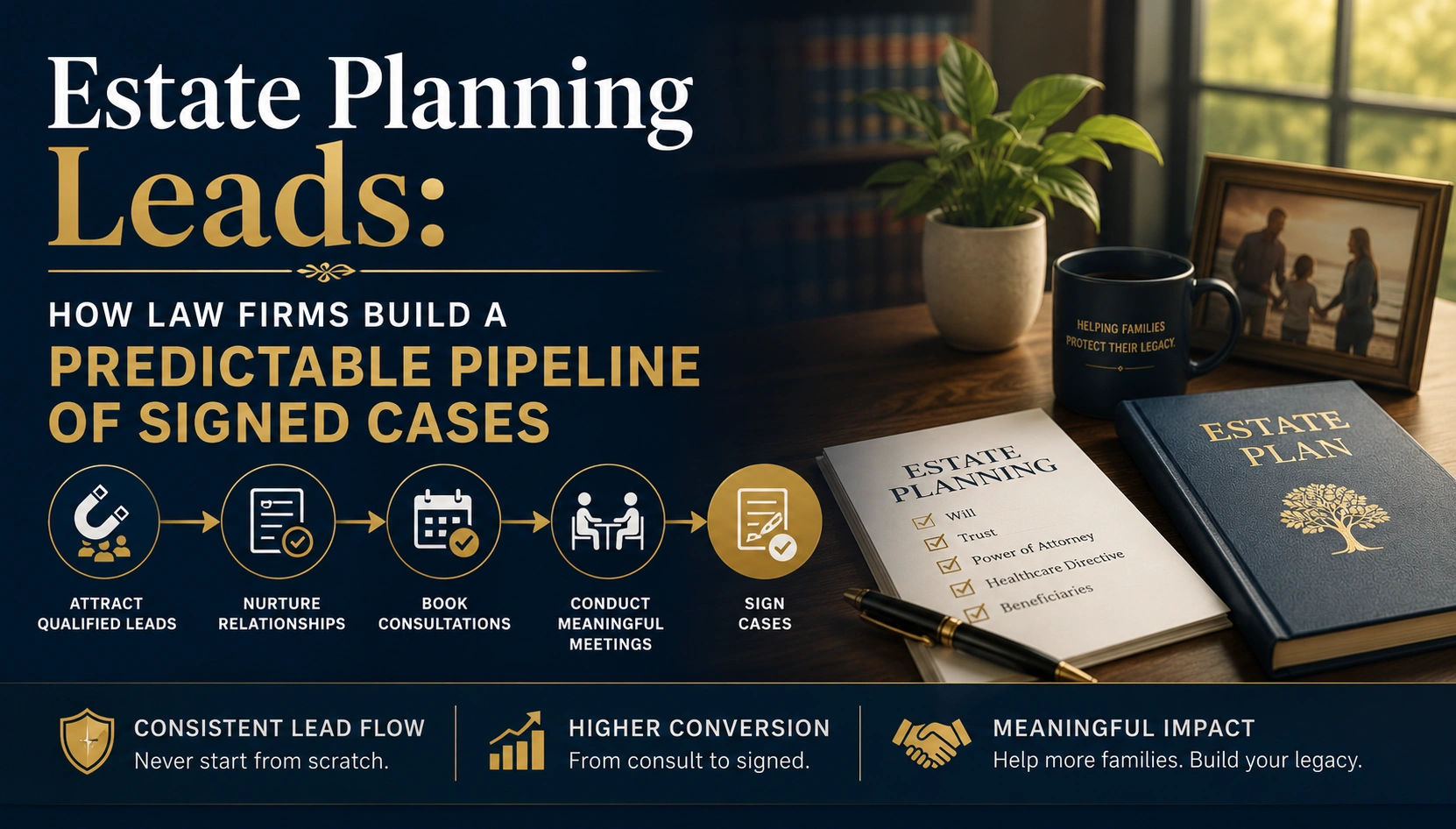
Estate Planning Leads: How Law Firms Build a Predictable Pipeline of Signed Cases
Estate planning leads are most valuable when they’re paired with fast follow-up and a real system, not just bought in bulk. This guide breaks down exclusive versus shared leads, what they actually cost per signed case, and how law firms like Berdan Law turned $8,315 in ad spend into $60,000 in signed-case revenue using paid ads, content, and CRM automation working together.
Every estate planning attorney has felt it.
The phone goes quiet, the calendar empties out, and a slow month turns into a scramble for new clients.
Estate planning leads are supposed to fix that problem.
But only if they actually turn into signed cases.
Plenty of firms spend money on ads, directories, or purchased lead lists and still end up with empty intake forms and dead-end phone calls.
The difference between a firm with a full calendar and one that’s always chasing its next client usually comes down to three things: where the leads come from, how fast someone follows up, and what happens after that first call.
This guide breaks down what estate planning leads actually are, what they cost, and how firms turn them into real, signed revenue.
What Are Estate Planning Leads?
Estate planning leads are potential clients who’ve shown interest in services like wills, trusts, powers of attorney, or probate planning.
They usually show this interest by searching online, filling out a form, or calling after seeing an ad.
Leads can come from paid lead services, search ads, referrals, or a firm’s own website.
Not every lead is created equal.
A general inquiry from someone who is “just looking into options” is very different from estate planning case leads, which come with enough detail to know the lead is serious: family situation, asset size, and a real reason to plan now, like a new grandchild or a recent diagnosis.
Some leads are shared with several firms at once.
Others are sold exclusively to a single firm.
That distinction matters more than almost anything else in this guide, and it’s covered in detail below.
Why Most Estate Planning Attorneys Run Out of Leads
For decades, estate planning firms grew almost entirely through referrals: a happy client tells a friend, a financial advisor sends someone over, a CPA mentions a name during tax season.
That model still works, but it has a ceiling.
56 percent of Americans still have no estate plan, which means most of the market hasn’t made a decision yet and isn’t waiting for a referral to act.
Will ownership has actually been falling in recent years, even as more people own assets worth protecting, which points to a gap between need and action rather than a shrinking market.
At the same time, low-cost DIY services have made price comparison the norm, and people increasingly search online before they ever ask a friend for a recommendation.
A firm that relies only on referrals is leaving most of its potential clients for someone else to find first.
That’s the gap estate planning leads are meant to close.
Should You Buy Estate Planning Leads or Generate Your Own?
Buying leads gets a firm into client conversations fast, but generating leads through paid search and a firm’s own website usually costs less per signed case over time.
Owned channels also give the firm full control of the relationship from the very first contact.
Most growing firms use a mix: bought leads to fill the pipeline early, and owned channels as the long-term foundation.
Exclusive vs. Shared Estate Planning Case Leads
Lead services typically sell leads one of two ways.
Shared leads go out to several firms at once and usually cost less, often in the $50 to $150 range per lead.
Exclusive leads go to one firm only, and they cost more, often $250 to $600 or higher.
The price gap makes sense once you look at what happens after the lead is sold.
With a shared lead, the prospect’s phone starts ringing from several different law offices within minutes, and most people stop answering by the third or fourth call.
Shared leads convert at roughly 2.5 percent, while exclusive leads convert at closer to 10 percent, simply because the prospect is only talking to one firm.
That single difference is why two firms can buy the same number of estate planning case leads and end up with very different results at the end of the month.
Lead generation agencies like us at Kaizen Growth put all the leads into our clients hands rather than selling them – which cuts the actual cost down substantially.
The Real Cost Per Signed Case (Not Just Cost Per Lead)
Cost per lead is the wrong number to focus on by itself.
What matters is cost per signed case, since that’s the number that actually shows up in revenue.
Once conversion rates are factored in, exclusive leads typically cost $1,500 to $3,000 per signed case, while shared leads run $3,000 to $6,000, even though the upfront price per lead looks cheaper for shared leads.
This is the math that gets missed when firms compare estate planning attorney leads purely by sticker price.
A firm that buys 40 shared leads at $75 each spends $3,000 and signs roughly one client at that 2.5 percent conversion rate.
A firm that buys 10 exclusive leads at $400 each spends $4,000 but signs roughly one client at a 10 percent conversion rate, with far less staff time spent chasing unresponsive prospects.
A firm that only looks at the cost of the lead, instead of the cost of the client, can end up paying more in the long run.
What Makes an Estate Planning Lead Actually Convert?
An estate planning lead converts when it’s contacted quickly, usually within five minutes, and followed up with a clear, repeatable process.
Firms that respond fast and stay in touch with automated reminders sign far more clients than firms that wait hours or rely on memory to follow up.
Speed to Lead
Leads contacted within five minutes are 21 times more likely to convert than leads contacted after thirty minutes.
Some firms see conversion jump by close to 400 percent when they respond within the first sixty seconds instead of waiting half an hour.
Most leads end up signing with whichever firm calls them back first, not necessarily the firm with the most experience or the best reviews.
That means a slow intake process can undo the value of even the best estate planning leads before a staff member ever picks up the phone.
A dedicated intake person, or an answering service that’s trained to handle the first call correctly, often pays for itself within the first few signed cases.
Follow-Up and CRM Automation
Estate planning is rarely an impulse decision.
Most prospects research for weeks or months before they sign with anyone, which means a single phone call isn’t enough.
A CRM system that sends automatic reminders, follow-up emails, and appointment confirmations keeps the firm in front of a prospect during that entire decision window.
A simple nurture sequence, like a reminder email two days after the first call, a short check-in a week later, and a final note before a planning deadline, often re-engages prospects who weren’t ready to book right away.
Without that kind of system, leads quietly go cold and end up signing with whichever firm happened to follow up last.
How to Generate Estate Planning Attorney Leads Online
Most law firms generate estate planning attorney leads online through a mix of paid search ads, Local Services Ads, and content that answers the questions people have before they ever call a lawyer.
Combining these channels with a fast intake process turns clicks into signed cases instead of wasted ad spend.
Google Ads and Local Services Ads
Paid search puts a firm in front of people who are actively searching for phrases like “estate planning lawyer near me” or “wills and trusts attorney.”
Local Services Ads add a layer of trust, since they show a firm’s reviews and a Google Guaranteed badge directly in the search results.
A dedicated landing page that matches the search, instead of sending traffic to a generic homepage, keeps more of those clicks from bouncing away.
Daily budget controls and ad scheduling also let a firm limit spend to business hours, when someone can actually answer the phone and respond while interest is still fresh.
Call tracking on every campaign shows exactly which keywords and ads are producing real estate planning case leads, not just clicks.
SEO and Content for Estate Planning Law Firms
Because the decision cycle is long, content that answers real questions, like the difference between a will and a trust, or what happens to a house in probate, keeps a firm visible while a prospect is still deciding.
This kind of content works alongside paid ads rather than replacing them, since it builds trust with people who aren’t ready to fill out a form yet.
Firms that combine both approaches generally see a steadier flow of estate planning leads for law firms than firms relying on a single channel.
Building integrated PPC, SEO, and CRM systems around a single intake process is what turns scattered traffic into a predictable pipeline.
A Real Example: $60,000 in Signed Cases from $8,315 in Ad Spend
Berdan Law PLLC is a solo estate planning practice handling wills and trusts.
Over three months, the firm spent $8,315 on Google Search Ads and Local Services Ads and generated 183 qualified leads at just under $40 each.
Those leads turned into $60,000 in signed case revenue, a return of more than eight times the ad spend.
The shift came from narrowing the targeting to estate planning intent only, removing unrelated services like general probate work, and tracking revenue back to signed cases instead of clicks.
Lead volume also grew 72 percent over the three-month period, showing the system kept improving rather than leveling off after the first month.
Berdan Law’s results show what happens when paid ads, tighter targeting, and real revenue tracking work together instead of running separately.
How Kaizen Growth Builds Estate Planning Lead Systems for Law Firms
Every firm featured in this guide eventually runs into the same question: how do you turn a handful of leads into a steady, repeatable pipeline?
Kaizen Growth works with estate planning attorneys to build a structured estate planning lead system instead of a one-off campaign.
That system combines paid search and Local Services Ads to bring in qualified leads, content that keeps the firm visible to people still deciding, and CRM automation that follows up the moment a lead comes in.
Each piece is built to work with the others, so a lead generated by an ad gets the same fast follow-up and nurture sequence as one that comes from a referral or the firm’s website.
Firms that want to see how this approach has worked for other practices can look through Kaizen’s case studies, including results from firms with a similar starting point.
The goal is a calendar that fills up on its own, month after month, instead of one that depends on remembering to ask for referrals.
Common Mistakes That Waste Estate Planning Leads
The most common mistakes that waste estate planning leads are slow response times, no follow-up system, buying cheap shared leads without tracking results, and sending ad traffic to a generic homepage instead of a page built for that search.
Fixing these issues usually costs less than buying more leads.
- Waiting hours, or even a full day, to call back a new lead, which lets a faster competitor sign the client first.
- Treating every lead the same, instead of qualifying which ones are ready to book a consultation now versus which ones need more time.
- Buying the cheapest shared leads available without tracking which ones actually turn into signed cases, which hides the real cost per client.
- Sending paid traffic to a generic homepage instead of a landing page that matches what the person searched for.
- Relying on one single channel, like only referrals or only paid ads, instead of combining a few sources that reinforce each other.
Estate planning leads aren’t the finish line, they’re the starting point.
What happens in the minutes and weeks after a lead comes in determines whether it becomes a signed case or a missed opportunity.
Kaizen Growth helps estate planning attorneys build the paid search, content, and follow-up systems that turn leads into a predictable client pipeline, instead of a guessing game.
Frequently Asked Questions
What is a good cost per lead for estate planning attorneys?
A reasonable cost per lead for estate planning attorneys usually falls between $50 and $150 for shared leads and $250 to $600 for exclusive leads, though the right number depends on the average value of a signed case and how well the firm converts leads into clients.
Are exclusive estate planning leads worth the extra cost?
Exclusive leads often cost more upfront, but they convert at a much higher rate since the prospect is only speaking with one firm instead of several, which usually makes the actual cost per signed case lower than cheaper shared leads.
How fast should a law firm respond to a new estate planning lead?
A law firm should aim to respond to a new estate planning lead within five minutes, since leads contacted that quickly are far more likely to convert than leads contacted after thirty minutes or longer.
Is SEO or PPC better for generating estate planning leads?
Paid search tends to generate leads faster, while content and search visibility build trust over the longer decision cycle most estate planning prospects go through, so most firms get the best results from combining both rather than choosing one over the other.
How many estate planning leads does it take to sign one client?
The number varies by firm and lead source, but exclusive leads generally convert at around 10 percent, meaning it takes roughly ten leads to sign one client, while shared leads convert at about 2.5 percent and require closer to forty leads for the same result.
Can CRM automation really improve lead conversion?
Yes, CRM automation improves lead conversion by making sure no lead is forgotten, automatically sending timely follow-up reminders and nurture emails so prospects stay engaged during the weeks or months it typically takes them to decide.