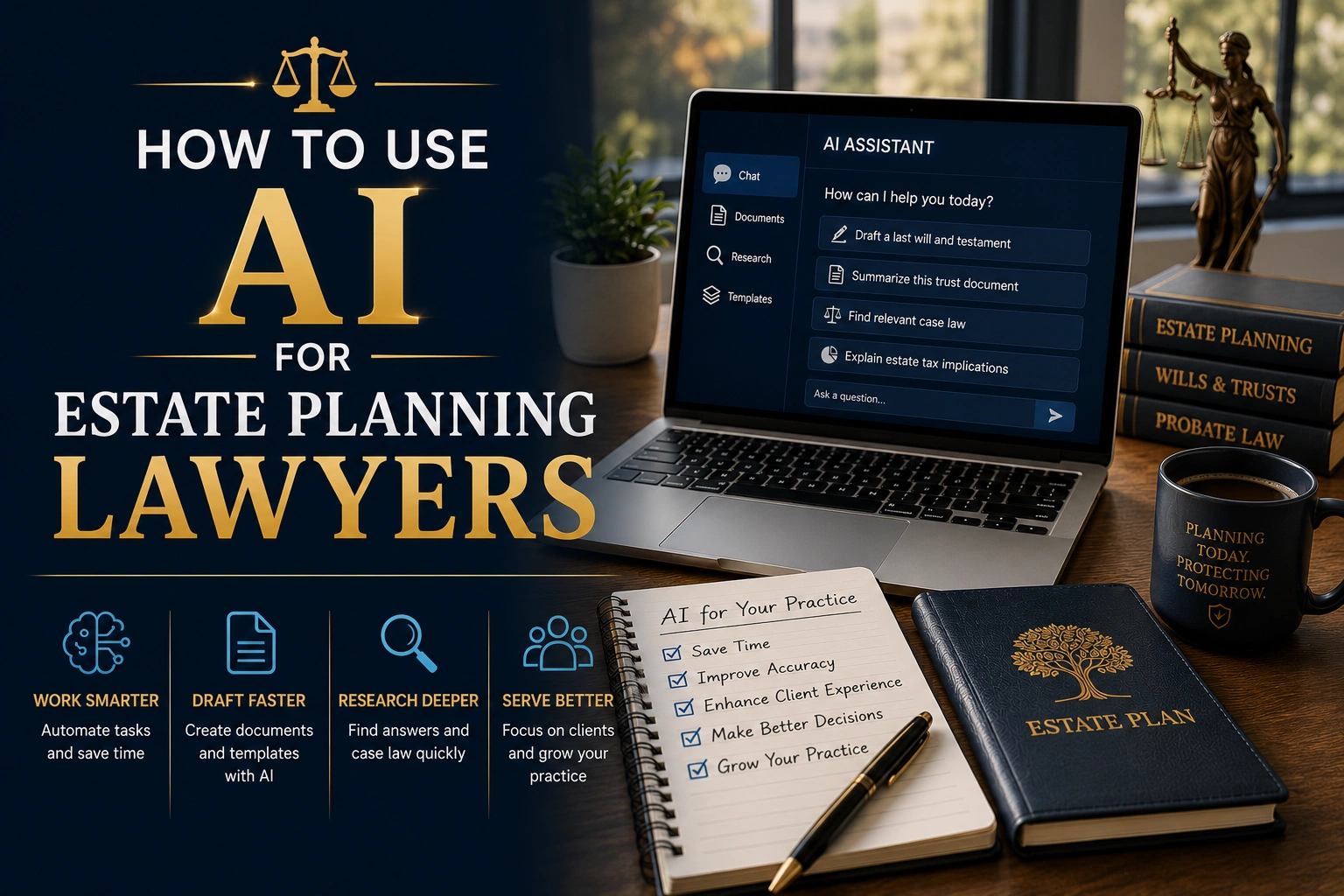
How to Use AI for Estate Planning Lawyers: Tools, Use Cases, & Ethics Rules
More estate planning lawyers are using AI than ever, but the tools that save time can also create real risk if used carelessly. This guide breaks down which AI tools estate planning firms actually use, what they’re genuinely good for, where confidentiality and privilege can break down, and the ethics rules every firm needs to follow before rolling AI into daily practice.
Estate planning lawyers are busier than ever, and AI is quickly becoming part of how firms keep up.
Learning how to use AI for estate planning lawyers means more than opening ChatGPT and typing in a question.
The tools that save the most time are also the ones that can create the most risk, especially when client details involve family conflict, unequal inheritances, or sensitive financial information.
This guide walks through which AI tools estate planning firms actually use, what they’re genuinely good for, where confidentiality and privilege can break down, and the ethics rules every firm needs to follow before AI becomes part of daily practice.
What Does It Mean to Use AI as an Estate Planning Lawyer?
Using AI as an estate planning lawyer means bringing generative tools like ChatGPT, Claude, or legal-specific platforms into tasks such as document review, legal research, and client communication, while keeping a lawyer’s judgment and oversight over every output.
It does not mean letting AI draft or finalize legal documents without review, since AI cannot practice law or take responsibility for its own mistakes.
AI works best as a starting point, not a finished product.
As one estate planning attorney put it in an ACTEC Foundation discussion on AI and document review, AI can help digest materials quickly and speed up client engagement, but it still needs a lawyer’s own critical thinking behind every suggestion it makes.
That distinction, AI as a starting point rather than a substitute, is really the core idea behind using AI responsibly in an estate planning practice.
How Many Estate Planning Lawyers Are Actually Using AI?
A large majority of lawyers now use generative AI in some form, with 79 percent of legal professionals reporting AI use in 2026, up from just 19 percent in 2023.
Firm-wide formal adoption still lags individual use, with only 41 percent of law firms saying their teams use AI in an official capacity, even though most of their individual lawyers already have.
That gap matters for estate planning firms specifically.
Many operate as solo practices or small teams, which means an individual attorney experimenting with AI on their own laptop, without a firm-wide policy, is more common than it should be.
Document review is the single most common use case reported by lawyers using AI, and CoCounsel advertises roughly a third average reduction in time spent on document review, research, and drafting for the firms that use it.
For a practice built on billable hours spent reading trusts, tax returns, and prior wills, that kind of time savings is hard to ignore.
Which AI Tools Do Estate Planning Firms Actually Use?
Estate planning firms generally reach for two categories of AI tools, and each comes with a different risk profile.
General-purpose consumer tools are the easiest to start with, while legal-specific platforms are built with law firm workflows and confidentiality in mind.
General-Purpose AI: ChatGPT and Claude
ChatGPT and Claude are the two general-purpose tools most estate planning lawyers reach for first, usually because they’re already familiar from personal use.
Both can summarize documents, draft first-pass language, explain legal concepts in plain English for a client, and answer research questions quickly.
The tradeoff is that these are consumer platforms first, which means a firm has to understand each tool’s specific data retention and training policies before using them on anything client-related.
Legal-Specific AI: CoCounsel and Others
Legal-specific platforms like CoCounsel from Thomson Reuters, Lexis+AI, and estate planning document automation tools are built directly on top of legal research databases and law firm data protections.
These tools tend to cost more than a consumer subscription, but they’re built for the kind of confidentiality and accuracy standards a law firm actually needs.
Because they’re trained and structured around legal work specifically, they also tend to produce fewer of the citation errors that show up when a general-purpose tool is pushed into legal research it wasn’t built for.
What Can AI Actually Do for an Estate Planning Practice?
AI is most useful in an estate planning practice for document review, summarizing lengthy trusts or tax returns, drafting first-pass language for wills and trusts, and speeding up client intake, while every output still needs a lawyer’s review before it reaches a client.
It is not yet reliable enough to replace legal judgment on drafting decisions or state-specific compliance.
One real-world example shared by an ACTEC Fellow involved using AI to review a dynasty trust for grantor trust provisions and divorce protection strategies, which cut down the time spent on a first read-through before the attorney’s own analysis took over.
That same pattern shows up across most practical use cases.
AI reads a long document and surfaces what matters, a lawyer decides what it means for the client.
Client communication is another strong use case.
AI can turn a dense explanation of a revocable trust or a power of attorney into something a client can actually understand, without changing the substance of the advice.
On the administrative side, AI can help with scheduling, meeting summaries, and first drafts of routine correspondence, freeing up attorney time for the parts of the job that actually require a law degree.
Where Does AI Put Client Confidentiality at Risk?
Public AI tools can put client confidentiality at risk because many store and use conversation data to train future models, and courts have already ruled that AI chat logs are not protected by attorney-client privilege unless the AI was used at the direction of counsel.
Estate planning firms face an extra layer of exposure since sensitive details about unequal inheritances or family conflict can become discoverable if a plan is ever challenged.
That risk isn’t theoretical anymore. In February 2026, a federal judge in United States v. Heppner ruled that a defendant’s written exchanges with an AI chatbot were not protected by attorney-client privilege, since the AI wasn’t a lawyer and wasn’t being used at counsel’s direction.
The same reasoning would apply just as easily to a client who drafts notes about their estate plan in a chatbot before ever speaking to their attorney.
Estate planning specific guidance from Cozen O’Connor warns against entering beneficiary names, dollar amounts, family conflict details, or draft plans into public AI tools at all, since that information could resurface as evidence if an estate is ever contested.
ABA Formal Opinion 512 backs this up directly, requiring lawyers to secure meaningful informed consent, not a generic waiver buried in an engagement letter, before using client information in any generative AI tool.
What Happens When AI Gets It Wrong?
AI still makes things up, and courts are no longer treating that as an innocent mistake.
U.S. courts logged 487 instances of AI errors or hallucinations showing up in filings during 2025, more than ten times the total from the year before.
An Oregon federal court handed down a $110,000 sanction against two lawyers after they submitted 23 fabricated citations and eight invented quotations, the largest AI-related penalty on record.
Estate planning work carries its own version of this risk, since a hallucinated statute or an outdated state requirement can quietly make a will or trust invalid instead of just embarrassing in a court filing.
ABA Formal Opinion 512 makes clear that this responsibility can’t be outsourced to the software.
Lawyers still have to independently verify anything AI produces before it goes into a client’s file, and uncritical reliance on an AI-generated answer is treated as a competence problem, not a technology problem.
How Should an Estate Planning Firm Actually Start Using AI?
The safest way for an estate planning firm to start using AI is with a written policy that limits what client information can be entered into any tool, requires a lawyer to review every output before it’s used, and documents informed consent when client matters are involved.
Starting with lower-risk tasks like internal research or first drafts of standard clauses, rather than sensitive client-specific details, lets a firm build comfort with the tools before expanding their use.
A simple rule helps here: a lawyer decides what goes into the tool, a lawyer reviews what comes out.
Nothing in between should be treated as final without that second look.
Firms that already pay for a legal research platform often find it easier to start with that platform’s built-in AI features, since the confidentiality protections are already part of the contract instead of an open question.
Training the whole team on what can and can’t be entered into a given tool matters just as much as picking the tool itself, since one associate’s shortcut can create exposure for the entire firm.
How Kaizen Growth Helps Estate Planning Firms Build Smarter Systems
AI can speed up the drafting and research side of an estate planning practice, but none of that matters if the intake process on the front end is still slow or inconsistent.
At Kaizen Growth, we focus on the other half of that equation: building automated follow-up the moment a lead comes in, so the time a firm saves with AI on the back end actually turns into more signed clients on the front end.
That means pairing paid ads and content with a CRM system that responds instantly, all built inside a firm’s broader marketing system instead of running as disconnected pieces.
We build an integrated PPC, SEO, and CRM system for estate planning firms specifically, which is the same systems-first approach the team at Kaizen Growth brings to every client we work with.
If your firm is using AI to save time internally, our team can help make sure that saved time turns into a fuller calendar instead of just a shorter to-do list.
How to Use AI for Estate Planning Lawyers: Frequently Asked Questions
Can estate planning lawyers use ChatGPT or Claude for client work?
Yes, but only with real caution about what goes into the tool. General-purpose tools like ChatGPT and Claude can help with research, summarizing documents, and drafting first-pass language, but client-specific details such as beneficiary names, asset values, or family conflict should generally stay out of consumer-facing AI tools unless a firm has confirmed how that data is stored and used.
Is it safe to enter client information into AI tools?
It depends entirely on the tool and the type of information. Many consumer AI platforms store and use conversation data to train future models, which is why ABA Formal Opinion 512 requires lawyers to get meaningful informed consent before entering client details into any generative AI tool, and why sensitive specifics are usually best left out entirely.
What did the Heppner ruling change about AI and attorney-client privilege?
In United States v. Heppner, a federal judge ruled that a defendant’s written exchanges with an AI chatbot were not protected by attorney-client privilege, since the AI was not a lawyer and was not being used at counsel’s direction. The ruling signals that anything typed into a public AI tool before or outside of attorney involvement could become discoverable later.
Can AI draft a legally valid will or trust on its own?
No. AI can produce a first draft of language, but it cannot verify state-specific execution requirements, confirm a client’s actual intent, or take legal responsibility for the document, which is why every AI draft still needs a licensed attorney’s review before it’s used.
What are the biggest risks of using AI in an estate planning practice?
The biggest risks are confidentiality exposure from entering sensitive client details into public tools, hallucinated citations or outdated legal requirements making it into a filing or document, and treating an AI-generated answer as final without independent verification.
What does ABA Formal Opinion 512 require before using AI on a client matter?
ABA Formal Opinion 512 requires lawyers to understand the capabilities and limitations of any AI tool they use, secure meaningful informed consent before entering client information into it, and independently verify AI-generated work rather than relying on it uncritically.