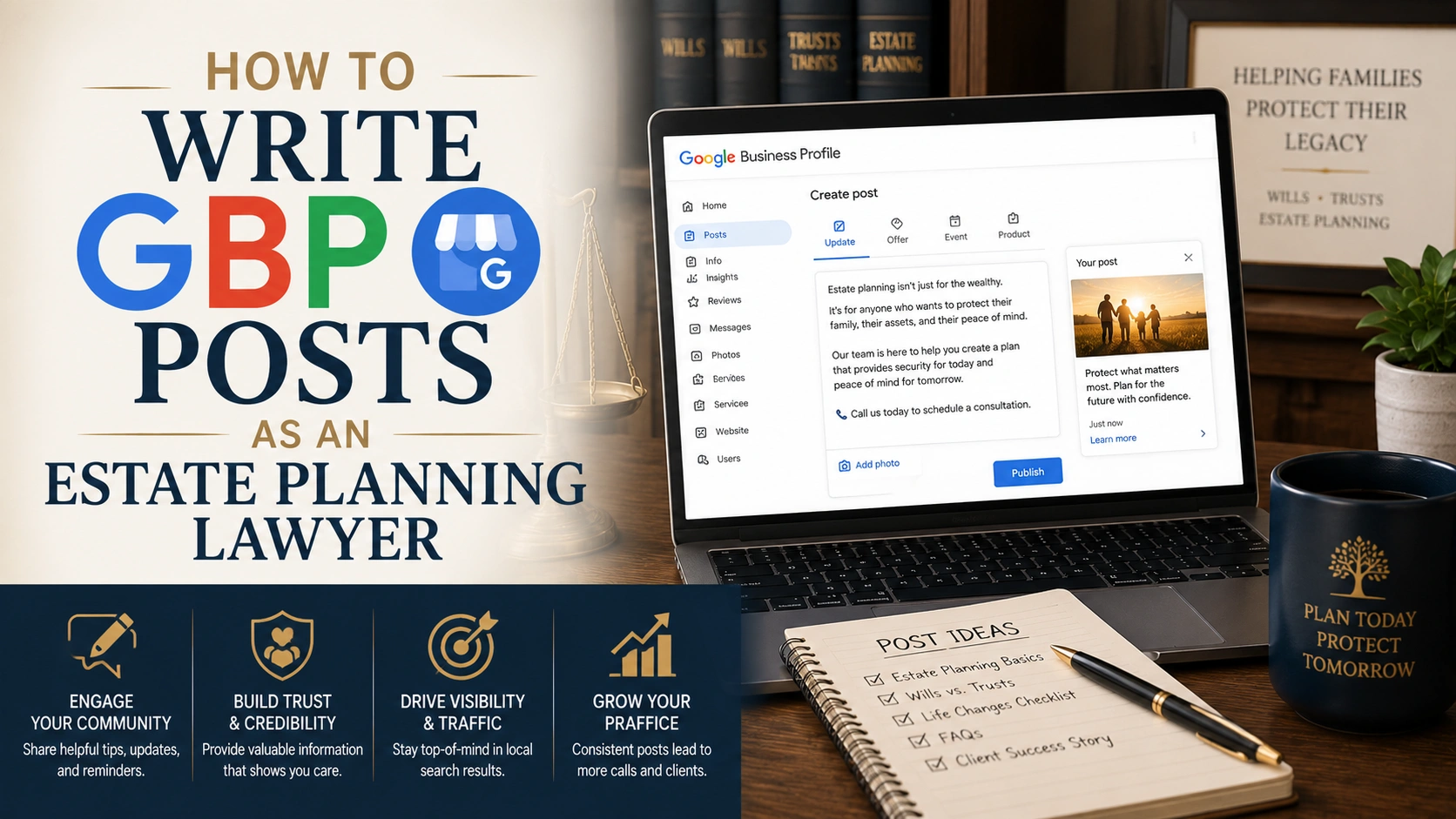
How to Write GBP Posts as an Estate Planning Lawyer: A Practical Guide
Estate planning lawyers get more from Google Business Profile when their posts do more than announce office hours. This guide covers the three GBP post types, seven post ideas built around real estate planning topics with example copy, how often to post, what language to avoid under legal advertising rules, and a simple weekly calendar you can start using this week.
A Google Business Profile with no posts looks like a business that stopped paying attention.
For an estate planning lawyer, that first impression can cost a client who is comparing a few firms before ever picking up the phone.
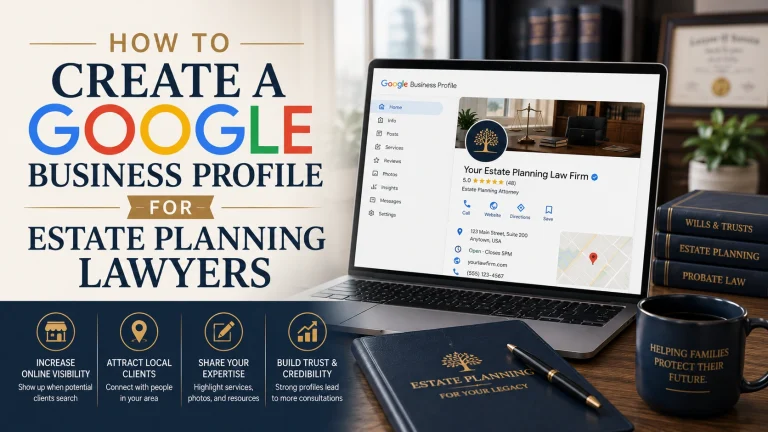
Setting up a Google Business Profile is the first step, but the profile only keeps working if it stays active.
Posts are the easiest way to do that, since they show up directly in the profile and give Google fresh signals that the practice is real and current.
The hard part isn’t knowing that posts matter.
It’s knowing what to actually write.
Most guides stop at “post regularly,” without saying what a good post for a wills and trusts practice actually looks like.
This guide covers the three types of GBP posts, seven ready-to-adapt ideas built around real estate planning topics, how often to post, what language to avoid under legal advertising rules, and a simple weekly calendar.
What Makes a GBP Post Actually Work for an Estate Planning Practice?
A GBP post works when it gives one specific piece of estate planning information, tells the reader what to do next, and reads like it was written by a real law firm instead of a template. Posts that are vague, generic, or purely promotional get skipped, no matter how often they’re published.
Google shows GBP posts directly in the map pack and knowledge panel, often before a visitor ever reaches the website.
That means a post is sometimes the only piece of content a potential client reads before deciding whether to call.
A post that says “check out our services” doesn’t tell that person anything they didn’t already know.
A post that explains how a revocable living trust helps a family avoid probate gives them an actual reason to click.
The posts that perform best answer a real question, point to one clear action, and sound like they came from a person, not a marketing department.
The 3 Types of GBP Posts You Can Use
Google Business Profile only offers three post formats: Update, Offer, and Event.
According to Google’s own posting guidelines, each format has its own required fields and its own purpose.
Knowing which one fits a given piece of content keeps a firm’s posts from feeling repetitive.
Update Posts
Update posts are the general-purpose option, built for a description, a photo or video, and a link with an action button.
They work well for educational content, like a short explanation of what a power of attorney actually covers.
Most of a firm’s posting calendar should be Update posts, since they cover any topic that doesn’t fit neatly into an offer or an event.
Offer Posts
Offer posts are built around a promotion and require a title, a start date, and an end date.
For an estate planning practice, that usually means a free initial consultation, a limited-time flat fee for a simple will, or a discounted planning package for a couple working together.
Offer posts also tend to perform the best of the three formats. One 2026 compilation of local search data puts their average click-through rate at 2.18 percent, compared to 1.34 percent for events and 0.56 percent for standard updates.
Event Posts
Event posts promote something happening on a specific date, like a free community seminar on wills and trusts or an office open house.
They require a title, a start date and time, and an end date and time.
For firms that host client education nights or partner with a local senior center, this format keeps that outreach visible on the profile for weeks before the date arrives.
How Long Should a GBP Post Be?
A GBP post should stay under 300 characters, with the most important information in the first 100 characters. Google’s app and mobile search results truncate longer posts, so anything past the first sentence or two often gets cut off before a reader sees it.
Google technically allows up to 1,500 characters, but that limit is not a target.
Posts under 300 characters consistently read better because they’re fully visible without a “read more” click.
A good rule of thumb is to write the single most useful sentence first, then add one or two supporting sentences after it.
If a post needs more room than that, it’s probably better suited to a blog post with a link back to it, not a GBP post.
How Often Should Estate Planning Lawyers Post on GBP?
Most estate planning firms should post to their Google Business Profile once or twice a week. That’s frequent enough to keep the profile active without turning posting into a daily chore that eats into billable time.
Posting weekly instead of monthly is tied to 28 percent more profile actions, like calls, direction requests, and website clicks, according to that same 2026 compilation of local search data.
That gap exists because an active profile reads as a sign the business is currently operating and paying attention, which affects how often it’s shown to nearby searchers.
Consistency matters more than volume. A firm that posts reliably every Tuesday will do better than one that posts five times in a week and then goes quiet for a month.
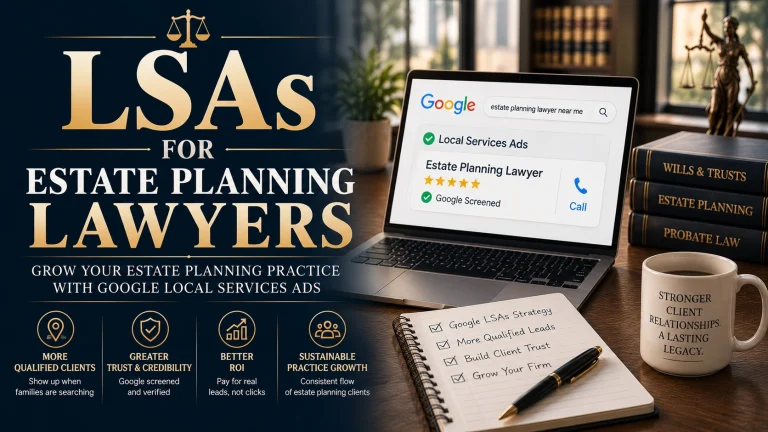
Posts work alongside paid visibility tools like Local Services Ads rather than replacing them, since a post keeps the free listing active while ads capture people who are ready to act right now.
7 GBP Post Ideas for Estate Planning Lawyers, With Example Copy
Here are seven post types that consistently work for estate planning practices, along with example copy that can be adapted to a specific firm.
Seasonal Estate Plan Check-In Reminders
The start of a new year, tax season, and open enrollment periods are natural moments to remind past and prospective clients to review their estate plan.
Example: “A new year is a good time to check that your will, trust, and beneficiary forms still match your wishes. Book a free review this month.”
Life-Event Triggers
A marriage, a new baby, a divorce, a retirement, or the sale of a business are all moments when an estate plan needs updating, and they give a firm something specific to post about.
Example: “Getting married or welcoming a new baby? Your beneficiary designations and guardianship choices may need an update. Call us to review your plan.”
Probate and Elder Law Tips
Short educational posts explaining probate basics, power of attorney, or elder law planning build trust with people who are still researching.
Example: “A properly funded trust can help your family avoid a long probate process. Ask us how trust funding works at your free consultation.”
Client Review Highlights
Sharing a short quote from a review, with the client’s permission, builds trust without revealing confidential case details.
Example: “One recent client said our team walked their family through a difficult probate with patience and clear answers. Read more reviews or start your own consultation.”
Firm News and Team Spotlights
A new attorney joining the firm, a promotion, a speaking engagement, or a bar association honor are all reasons to post, and they help the profile feel like it’s run by real people.
Example: “We’re glad to welcome our newest estate planning attorney to the team. Read more about their background and how they can help your family plan ahead.”
Free Consultation Offers
A limited-time offer, like a free initial consultation or a flat fee for a simple will, fits Google’s Offer post format and includes an automatic “View Offer” button.
Example: “Free estate planning consultation this month. Bring your questions about wills, trusts, or guardianship.”
Community and CLE Event Posts
Client education seminars, continuing legal education talks, or a table at a local senior resource fair all fit the Event post format and stay visible on the profile until the date passes.
Example: “Join us for a free community workshop on wills and trusts. Seating is limited, reserve your spot today.”
What Should Estate Planning Lawyers Avoid Writing in a GBP Post?
Estate planning lawyers should avoid guaranteeing a specific outcome, comparing their results to another firm’s, or including a phone number in the post text, since Google often rejects posts that contain one. Legal advertising rules add a second layer: any claim in the post needs to be something the firm can actually back up.
Rule 7.1’s ban on unsubstantiated claims applies to a GBP post the same way it applies to a billboard or a website, since it covers any communication about a lawyer’s services.
That rules out language like “guaranteed results” or “we always win,” along with softer phrasing that still implies a promised outcome.
It also means avoiding comparisons that can’t be proven, like calling the firm the area’s top-rated practice without a specific, verifiable source behind that claim.
On the technical side, a post that includes a phone number in the description can get rejected, so any call to action should point to a link instead.
Naming a specific client’s case details, even in a positive light, risks a confidentiality problem that a general description of the service doesn’t.
How Do You Build a Weekly GBP Posting Calendar for Estate Planning Firms?
A weekly GBP posting calendar for an estate planning firm works best as a repeating four-week rotation: one educational post, one review highlight, one seasonal or life-event reminder, and one firm news, offer, or event post. That pattern keeps the profile active without requiring a brand new idea from scratch every week.
The estate planning firms we’ve worked with tend to do best when they follow a simple, repeatable pattern like this instead of starting from a blank page each time.
- Week 1: An educational Update post on a core estate planning topic, like the difference between a will and a trust.
- Week 2: A client review highlight, shared with permission.
- Week 3: A life-event or seasonal reminder tied to the current time of year.
- Week 4: A firm news update, an Offer post, or an upcoming Event post, depending on what’s happening that month.
Repeating that four-week rotation gives a firm a full year of post ideas without having to plan every single week from scratch.
Using AI as a starting draft can speed up writing a month of posts at once, as long as an attorney reviews the language before anything goes live.
How Kaizen Growth Helps Estate Planning Firms Turn GBP Posts Into Signed Cases
Writing consistent GBP posts is only one piece of building a steady flow of estate planning clients.
Kaizen Growth builds an integrated estate planning marketing system that combines paid search, Local Services Ads, organic content, and CRM follow-up, so a post is never working alone.
That means a lead who clicks through from a GBP post gets the same fast follow-up as a lead who calls after seeing a paid ad, instead of falling through the cracks between separate tools.
The goal is turning local searches into signed leads, not just profile views or clicks that never become a client.
One estate planning firm working with Kaizen turned $8,315 in ad spend into $60,000 in signed case revenue over three months, a result documented in their case study.
Firms that want a posting calendar and a follow-up system built around their own profile can reach out to get started.
Frequently Asked Questions
How often should an estate planning law firm post on Google Business Profile?
Most estate planning law firms should post once or twice a week, since that pace keeps the profile active without becoming a daily burden, and research on local business profiles ties weekly posting to roughly 28 percent more profile actions, like calls and direction requests, compared to monthly posting.
What’s the difference between an Update, Offer, and Event post?
An Update post is the general-purpose format for sharing information with a photo and a link, an Offer post promotes a specific deal like a free consultation and requires start and end dates, and an Event post promotes something happening on a specific date, like a client education seminar, and requires a start and end date and time.
Can estate planning lawyers mention case results in a GBP post?
Estate planning lawyers should avoid mentioning specific case results or client details in a GBP post, both because it risks a client confidentiality issue and because legal advertising rules like ABA Rule 7.1 prohibit claims that create unjustified expectations about outcomes. A general description of the service, like helping a family set up a trust, is safer than naming a result.
Do GBP posts actually help a firm show up more in local search?
GBP posts aren’t a guaranteed way to move up in local search results by themselves, but an active profile with regular posts, complete information, and current reviews tends to show up more often and look more trustworthy than a profile that looks abandoned, since posts give Google fresh content to associate with the business.
How long do Google Business Profile posts stay live?
Update and Offer posts typically stay visible for about seven days unless an Offer includes its own end date, while Event posts stay visible until the event’s end date passes, and older posts are generally archived after about six months.
Can GBP posts be scheduled in advance?
Yes, Google Business Profile posts can be scheduled ahead of time, either directly through the profile manager or through approved third-party scheduling tools, which makes it easier for a firm to draft a month of posts in one sitting and have them go out automatically each week.