Estate Planning Ads: The Channels, Costs, and Rules That Bring In Signed Clients
Estate planning ads can turn Google searches and social scrolling into signed clients, but only when the channel, message, and compliance are right. This guide breaks down what estate planning ads cost in 2026, which platforms perform best, how bar advertising rules apply, and what separates an ad that gets clicked from one that gets a client to call.
Most estate planning attorneys already know referrals only go so far.
Estate planning ads are how firms turn people who are actively searching, or scrolling, into clients who actually book a consultation.
But estate planning ads work differently than ads for personal injury or criminal defense.
The buyer is older, the decision takes longer, and the wrong message can turn a click into wasted budget instead of a signed case.
This guide walks through what estate planning ads actually cost, which channels perform best, what makes the ad itself convert, and the bar advertising rules every campaign has to follow.
Why Estate Planning Ads Are Different From Other Legal Ads
Estate planning ads work on a longer timeline than most legal advertising because the decision to create a will or trust rarely feels urgent, even though it matters.
The average client is older, often researches for weeks before calling, and responds more to trust and clarity than to aggressive sales language.
Estate planning isn’t a crisis purchase the way a DUI charge or a car accident is.
Nobody wakes up in pain and searches for a trust attorney the same day.
Instead, the decision gets triggered by life events: a health scare, a new grandchild, a parent’s death, a divorce, or simply turning 60.
Good ads speak to these moments instead of talking generically about “estate planning services.”
The gap in the market is bigger than most firms realize.
A 2026 report from Trust & Will found that 56 percent of American adults still have no estate planning documents at all, a number that has barely moved in the last year.
The same report found that will ownership actually dropped from 31 percent to 26 percent year over year, even as trust ownership rose.
Gen X carries the highest unprotected rate of any generation, with 62 percent having no estate plan in place.
That combination of a large, underserved audience and a slow-moving decision is exactly why estate planning ads need patience built into the strategy, not just a single call to action.
What Do Estate Planning Ads Actually Cost?
Estate planning ads typically cost between $8 and $35 per click on Google Search, $40 to $90 per qualified lead through Local Services Ads, and around $78 per lead on Facebook.
Most firms need a minimum of $3,000 to $5,000 a month in a single metro area to generate enough click volume to actually optimize a campaign.
That said, Kaizen Growth’s guarantee comes at $1,500 to $2,000 of monthly ad spend (feel free to ask us how we achieve this).
Cost varies a lot by market and keyword.
Tier one metros like Los Angeles, New York, and Chicago sit at the high end of that click range, while smaller markets and rural counties can run 30 to 50 percent cheaper.
Keywords tied to specific services like revocable trusts or asset protection tend to cost more per click than general “estate planning attorney” terms.
Cost per click isn’t the number that matters most, though.
Cost per signed client is.
A well-run estate planning campaign should produce leads at $80 to $200 each, and it typically takes three to five leads to sign one client, which puts the real cost per signed client somewhere between $300 and $800.
Legal advertisers already pay some of the highest rates on the major platforms: attorneys and legal services have the highest average cost per click on Google Ads of any industry, at $9.87, and legal services also carry the highest cost per lead on Facebook, at $78.26.
Which Ad Channels Actually Work for Estate Planning Firms
Not every platform performs the same way for estate planning, and ads tend to perform even better when they sit inside a broader estate planning marketing system instead of running alone.
Some channels are built for people actively searching, while others work better for staying visible to people who aren’t ready yet.
Google Local Services Ads
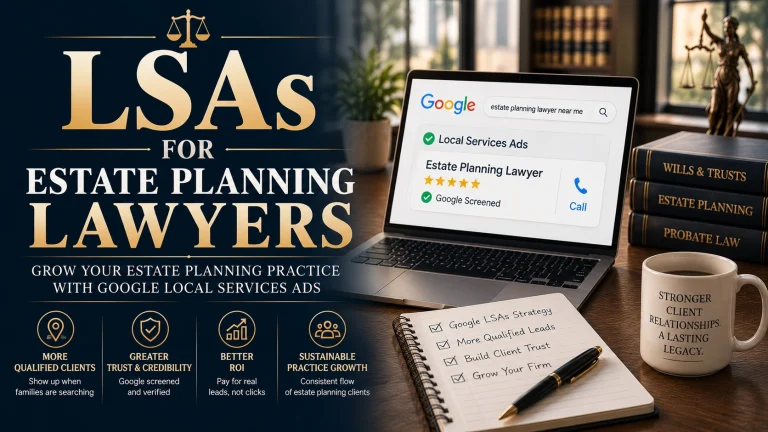
Local Services Ads charge per lead instead of per click, which makes budgets more predictable.
Local Services Ads for estate planning are now live in most U.S. metros and are currently one of the highest-converting paid placements available to firms.
To run them, a firm has to get “Google Screened,” which involves verifying each attorney’s standing with their state bar, along with a criminal and civil background check for at least one partner at the firm, rather than a background check for every single attorney.
Google Search Ads
Search ads capture people who are already typing in terms like “living trust attorney” or “how much does a will cost.”
That intent makes search one of the more reliable channels, though it comes at a higher price per click than most other platforms.
Because the keywords are specific, the ad copy and landing page both need to match what the searcher typed, not just the general practice area.
Facebook and Instagram Ads
Social ads are one of the most underused channels in estate planning, mostly because firms assume social media is only for younger audiences.
In reality, Facebook’s user base skews older, which lines up well with the estate planning audience.
Social platforms are better at building awareness and staying in front of pre-retirees, business owners, and new parents than at closing a case on the first impression.
Retargeting Ads
Because the decision cycle is long, most people who visit an estate planning website the first time aren’t ready to call yet.
Retargeting ads follow those visitors around the web afterward, at a much lower cost than the first click that brought them to the site.
It’s one of the cheapest ways to stay visible during the weeks someone spends thinking it over.
What Makes an Estate Planning Ad Actually Convert?
The estate planning ads that convert are the ones that educate first and sell second, using plain language about protecting family, avoiding probate, or naming a guardian, then offering one clear next step like a free consultation.
Ads that lean on fear or urgency tend to underperform, because that tone clashes with how people actually make this decision.
Good creative speaks to a specific moment in someone’s life instead of a generic service.
An ad aimed at new parents might focus on naming a guardian.
An ad aimed at retirees might focus on avoiding probate for a family home.
Each version should feel like it was written for that exact reader, not for everyone at once.
Trust signals matter more here than in almost any other legal niche.
Reviews, credentials, and clear photos of the actual attorney tend to outperform stock imagery and generic law firm branding.
Every ad should end with one clear action, whether that’s booking a consultation or downloading a simple guide, since asking for two things at once tends to lower conversion on both.
Do Estate Planning Ads Have to Follow Bar Advertising Rules?
Yes.
Estate planning ads are attorney advertising, so they have to be truthful, avoid guaranteeing outcomes, and sometimes need a specific disclaimer depending on the state.
Rules vary slightly by state bar, but the core standard everywhere is that an ad cannot mislead a potential client about services, fees, or results.
Most states build their rules on the ABA’s Model Rules 7.1 and 7.2, which prohibit false or misleading advertising and paying for referrals.
A few specific rules trip up firms more than others.
Attorneys can only describe themselves as “specialized” in estate planning if they genuinely limit their practice to that area, not as a marketing label.
Testimonials can’t be paid for or compensated in any way, and any mention of past case results needs a disclaimer that outcomes depend on each client’s specific situation.
Some states, including New York, require certain ads to be labeled with a disclaimer such as “Attorney Advertising”.
It’s also worth building a habit of saving copies of every ad, since most states require attorneys to keep records of advertisements for at least a couple of years after they run.
How to Know If Your Estate Planning Ads Are Actually Working
Cost per lead is the easiest number to track, but it isn’t the one that tells the real story.
Cost per signed client does.
A campaign that produces cheap leads that never convert is more expensive in the long run than one with a higher cost per lead but a much higher close rate.
That’s the real difference between exclusive leads, which cost more but convert at a meaningfully higher rate, and shared leads sold to multiple firms at once.
Follow-up speed changes these numbers more than almost any other factor.
A lead that sits in an inbox for a day has already cooled off by the time someone calls back.
Firms that build in fast, automated follow-up tend to turn a meaningfully higher share of their ad spend into actual signed cases, which is really the only number that matters at the end of a campaign.
How Kaizen Growth Helps Estate Planning Firms Run Ads That Convert
Running estate planning ads well takes more than picking a platform and setting a budget.
At Kaizen Growth, our approach pairs paid ads with an integrated system that also includes SEO and CRM automation, so a click doesn’t just turn into a lead, it turns into a follow-up call, a booked consultation, and eventually a signed case.
We’ve seen this play out directly with the firms we work with.
One estate planning firm we partnered with turned $8,315 in ad spend into $60,000 in signed-case revenue within a few months of launching a coordinated campaign.
That kind of result comes from treating ads as one part of a larger system rather than a standalone tactic, which is the same philosophy the team behind Kaizen Growth brings to every estate planning firm we work with.
If your firm is ready to turn estate planning ads into a predictable source of signed clients, our team can build and manage that system for you from the first click through the signed engagement letter.
Estate Planning Ads: Frequently Asked Questions
How much does it cost to advertise estate planning services?
Most firms should plan on $8 to $35 per click on Google Search, $40 to $90 per qualified lead through Local Services Ads, and a minimum monthly budget of $3,000 to $5,000 in a single metro area. Once leads convert into signed clients, the real cost usually lands between $300 and $800 per signed case, since it typically takes three to five leads to close one client.
Are Google Local Services Ads worth it for estate planning attorneys?
Yes, for most firms. Local Services Ads charge per lead instead of per click, which makes the budget more predictable, and they currently rank among the highest-converting paid placements available to estate planning firms, though getting approved requires bar verification and a background check for at least one partner at the firm.
Can estate planning attorneys advertise on Facebook and Instagram?
Yes, and it’s an underused channel in this practice area. Facebook’s user base skews older than most people assume, which lines up well with the typical estate planning client, and the platform tends to work best for building awareness and staying visible rather than closing a case on the first click.
What advertising rules do estate planning attorneys need to follow?
Every ad has to be truthful and cannot mislead a potential client about services, fees, or results, following the ABA’s Model Rules 7.1 and 7.2 that most states build their own bar rules on. Attorneys also can’t pay for testimonials, can only call themselves “specialized” if they genuinely limit their practice to that area, and some states require ads to carry a specific disclaimer.
How long does it take for estate planning ads to generate signed clients?
Because the decision cycle is longer than most legal practice areas, it often takes weeks of research before someone calls, which is why retargeting and consistent visibility matter as much as the first click. Most firms should expect to run a campaign for at least a full month before judging results, since a short test rarely produces enough volume to draw conclusions.
Should estate planning firms use exclusive or shared leads?
Exclusive leads cost more upfront but convert at a meaningfully higher rate than shared leads, which get sold to multiple firms at the same time. For a practice area built on trust, that faster, less competitive follow-up usually produces a lower cost per signed client even though the sticker price per lead is higher.